How it works
A learning path that can explain every decision it makes
No black boxes. Each activity your child sees can be traced back to a curriculum outcome, a diagnostic result and a mastery calculation.
In three simple steps
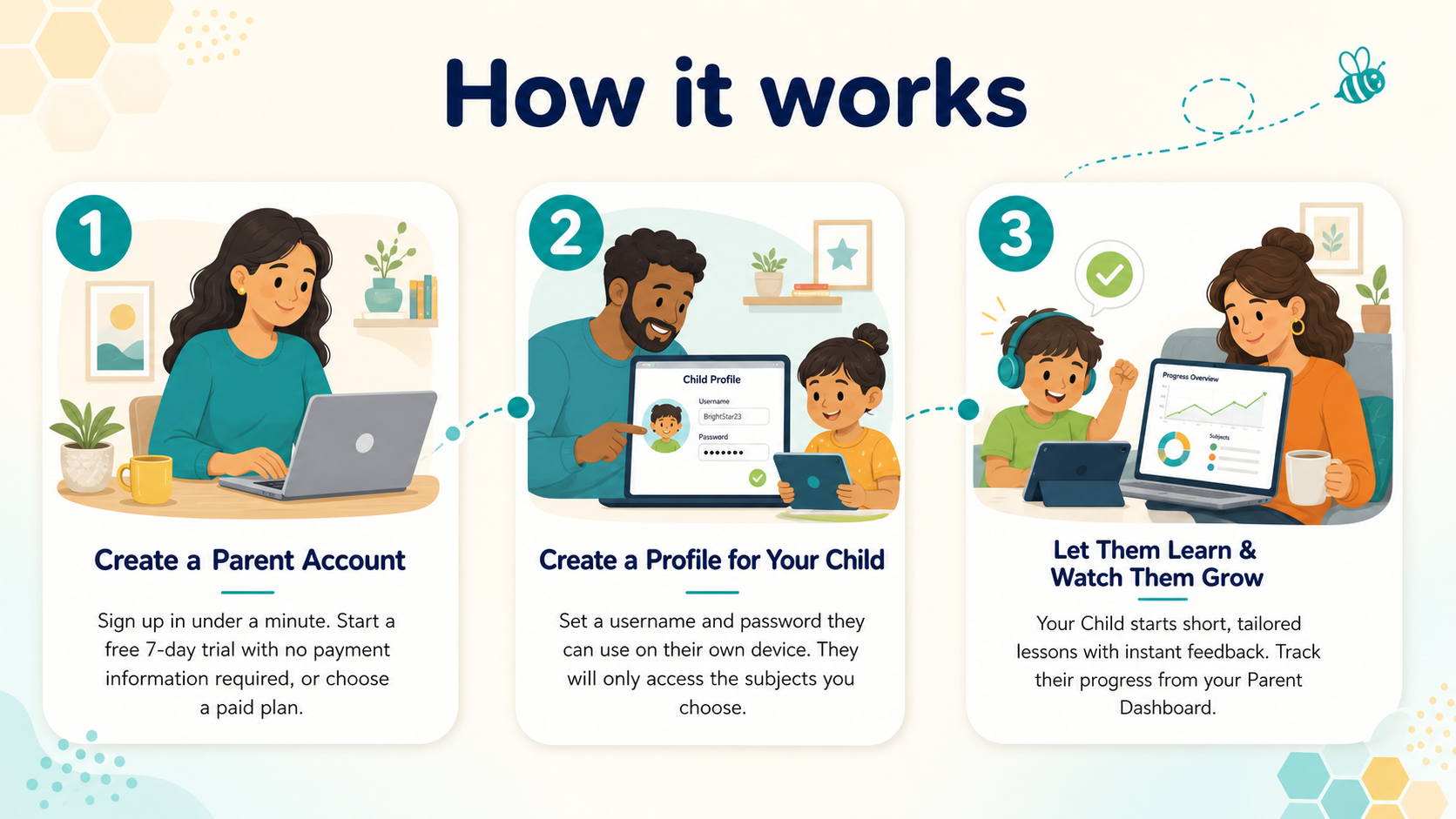
How it works
NestingBee Learning fits around your family. From sign-up to your child’s first lesson in minutes.
1. Choose the curriculum, not a country label
Jurisdiction → education system → framework → framework version → stage → year level → subjects. Each level shows whether it is available now, in pilot, or coming soon, so nobody is signed up to an empty dashboard.
2. Set goals and session shape
General progress, catch up, confidence, stretch, transition or exam preparation. You also set how many sessions a week and how many minutes each one should run.
3. Diagnostic placement
A short adaptive check across the chosen subjects. It is resumable — a closed tab loses nothing — and every response write is idempotent, so a flaky connection cannot double-count an answer.
4. A four-week plan
Generated deterministically from the diagnostic and the curriculum outcome graph: prerequisites first, then the year's outcomes, with review slots for anything that has decayed.
5. Lessons and practice
Progressive reveal, worked examples, hints that cost nothing but are recorded, transcripts for every audio, and eight objective question types including cloze, matching, ordering and numeric entry.
6. Marking and mastery
Marking is deterministic: exact match, multi-answer, numeric tolerance, unit handling, fraction equivalence and spelling modes. Mastery blends correctness, recency, difficulty, diversity of evidence and hint use into Mastered, Secure, Developing, Emerging, Needs review or Insufficient evidence.
7. Reporting you can act on
Per child: strengths, gaps, what review is due, how much evidence exists, and one recommended next action. Where evidence is thin we say so rather than inventing a score.